Water quality is a medical issue
The Cost of Bad Water
Purifying water to medical grade costs $2. The dialysis you need when your kidneys fail costs $50.
The world spends $350 billion a year on water infrastructure, and almost none of it reaches clinical-grade purification. In sub-Saharan Africa, 9 in 10 people who need dialysis never receive it.
Dialysis costs 25× the water purification step that precedes it
One center for six million.
Grateful to the leadership at Amoud Foundation for hosting me in Jigjiga, Ethiopia in late 2025. I went to look at the healthcare infrastructure. I didn’t expect to spend most of my time thinking about water.
The dialysis center there serves six million people. It has eleven working machines and four broken ones. There are thirty patients currently in treatment and eighty-five on a waiting list.
Each patient needs treatment three times a week, four hours each session. That’s a 12-hour commitment, every week, for the rest of their life. When a machine breaks there’s often no one to fix it. The technicians who get trained leave for better jobs in other countries.
A partnership with the regional government subsidizes treatment so patients pay $5 per session instead of the full $50 cost.
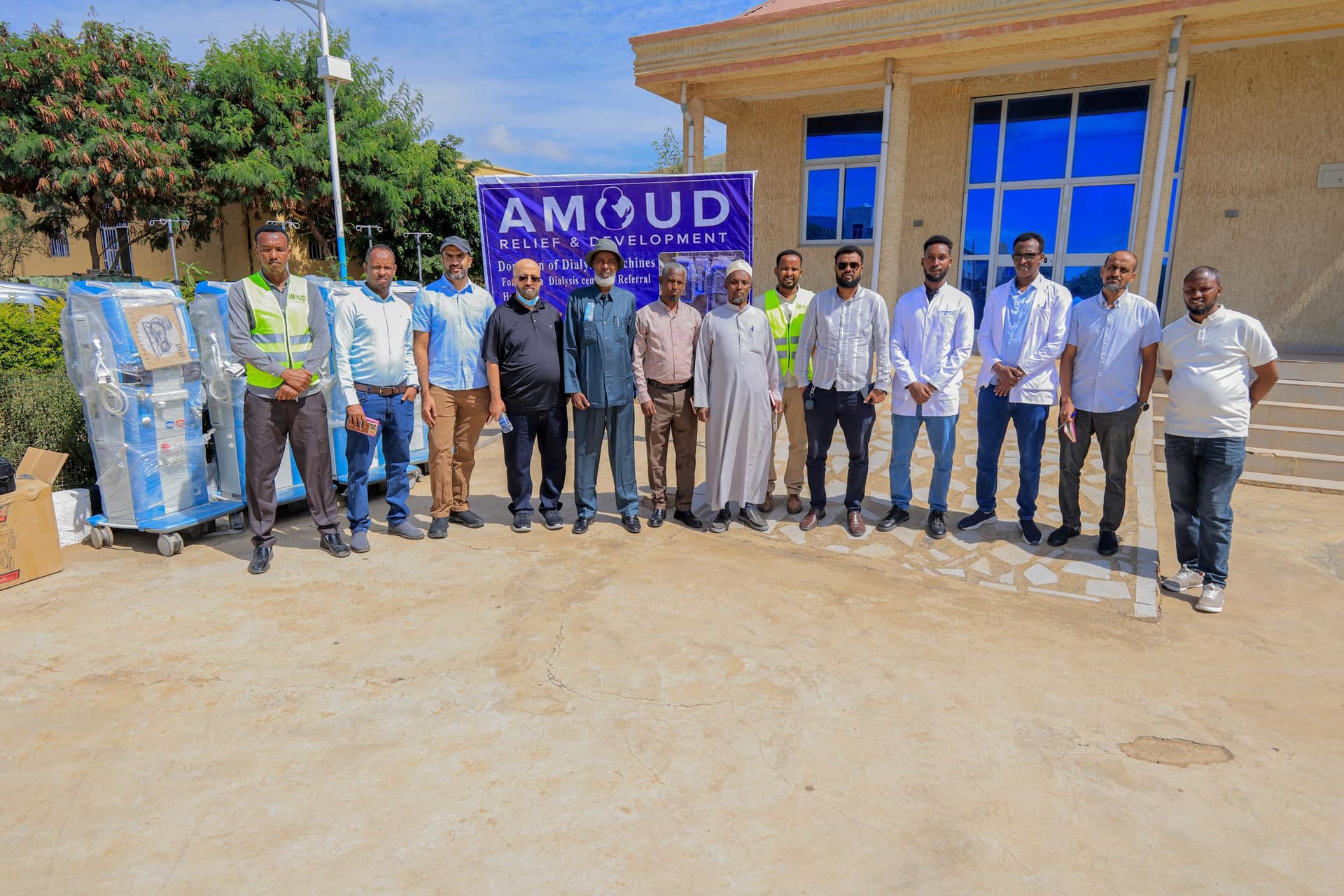
Jigjiga dialysis center, October 2025 field assessment. Pictured: Amoud Foundation President Mohamoud Egal, Executive Director Issam Abdallah, Ethiopia Country Director Abdul Kadir, and Mazhar Memon of CharitySense, alongside dialysis medical and executive staff.
Bad water is a big problem
In parts of eastern Ethiopia, tap water runs at 1,380 ppm total dissolved solids, nearly 3x what the EPA considers safe for drinking. The dialysis team in Jigjiga explained what that does to a body over time: kidneys filter dissolved minerals from blood, and when the mineral load stays chronically high, excess calcium, fluoride, and other minerals deposit as microscopic crystals in the kidney tubules, causing scarring and slow loss of function.
Fluoride is a major part of the problem. A global hazard map estimates 180 million people are exposed to unsafe fluoride levels in groundwater. The Ethiopian Rift Valley is one of the worst-affected regions: groundwater fluoride reaches 7.8 to 18 mg/L, up to 12x the WHO limit, and up to 8 million people drink it daily.
Researchers call the pattern chronic kidney disease of unknown etiology (CKDu). In Sri Lanka, studies found fluoride in 99% of wells in CKDu-endemic areas and linked water hardness to disease prevalence. The pattern repeats wherever high-mineral groundwater is the primary drinking source.
Not all kidney disease comes from water. Diabetes and high blood pressure are the two largest drivers globally. The Global Burden of Disease Study 2023 identified them as the leading risk factors. But in regions with high-TDS water, water quality adds a third compounding cause that most water infrastructure programs aren’t built to address.
A crisis that doubled in 30 years
Chronic kidney disease now affects nearly 800 million adults worldwide, more than double the number in 1990. It is the ninth leading cause of death globally, killing nearly 1.5 million people per year.
According to The Lancet Global Health, 84% of newly diagnosed end-stage kidney disease patients in sub-Saharan Africa discontinue dialysis. The primary reason: they cannot pay. Most die within weeks.
CKD prevalence by region
Healthcare workforce gap
Dialysis basics
Your kidneys are a filter. When they fail, you need an external one. Three times a week, blood leaves your body, passes through a bundle of hollow fibers while a cleaning solution removes the waste from the other side, and returns. That’s it.
The dialyzer, the actual filter, contains around 15,000 fibers thinner than a human hair. Your kidneys normally process about 180 liters of blood per day. The dialyzer replicates this across four hours, processing your entire blood volume multiple times.
The blood pump moves 200 to 400 mL/min. The dialysate flows at 500 to 800 mL/min, consuming about 120 liters per session. Blood out, membrane filter, blood back.
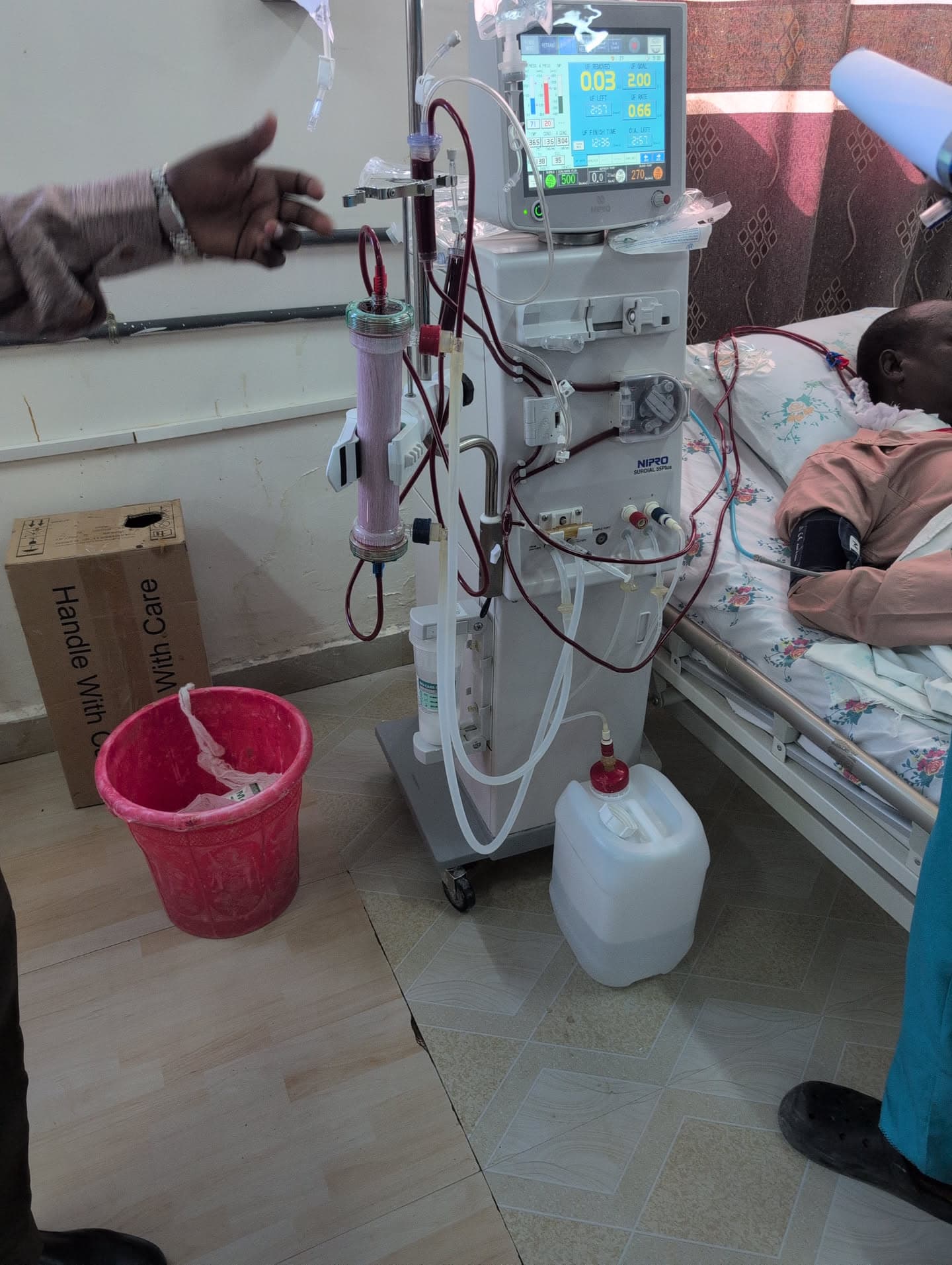
The dialysis unit at Jigjiga, eastern Ethiopia. The only center serving a population of six million.
Per-session consumables (hover to explore)
Cost ranges from Karopadi et al., BMC Health Services Research 2013. Consumables account for 70 to 85% of session cost in low-income settings.
The only hard part: water quality
The cost question starts with water. Of the $50 it costs to run a session, $2 goes to purification, the most fundamental input and the one most directly linked to where patients live.
Drinking water standards sit at 500 ppm. Dialysis water has to be under 10 ppm, fifty times stricter than the drinking water standard. A single reverse osmosis unit brings that down to dialysis grade. One unit serves an entire center. It costs $5,000 to $15,000.
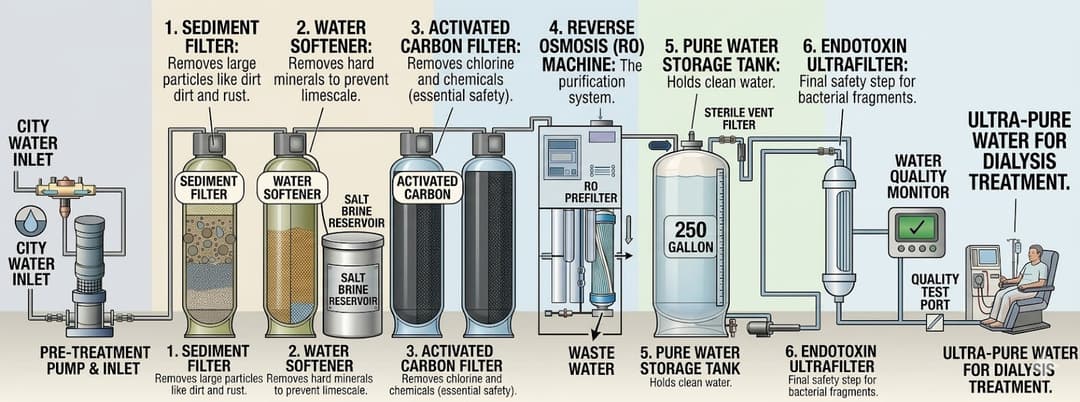
A typical RO system. Tap water enters under pressure; membranes reject dissolved solids; ultrapure water exits. Adapted from Renal Fellow Network.
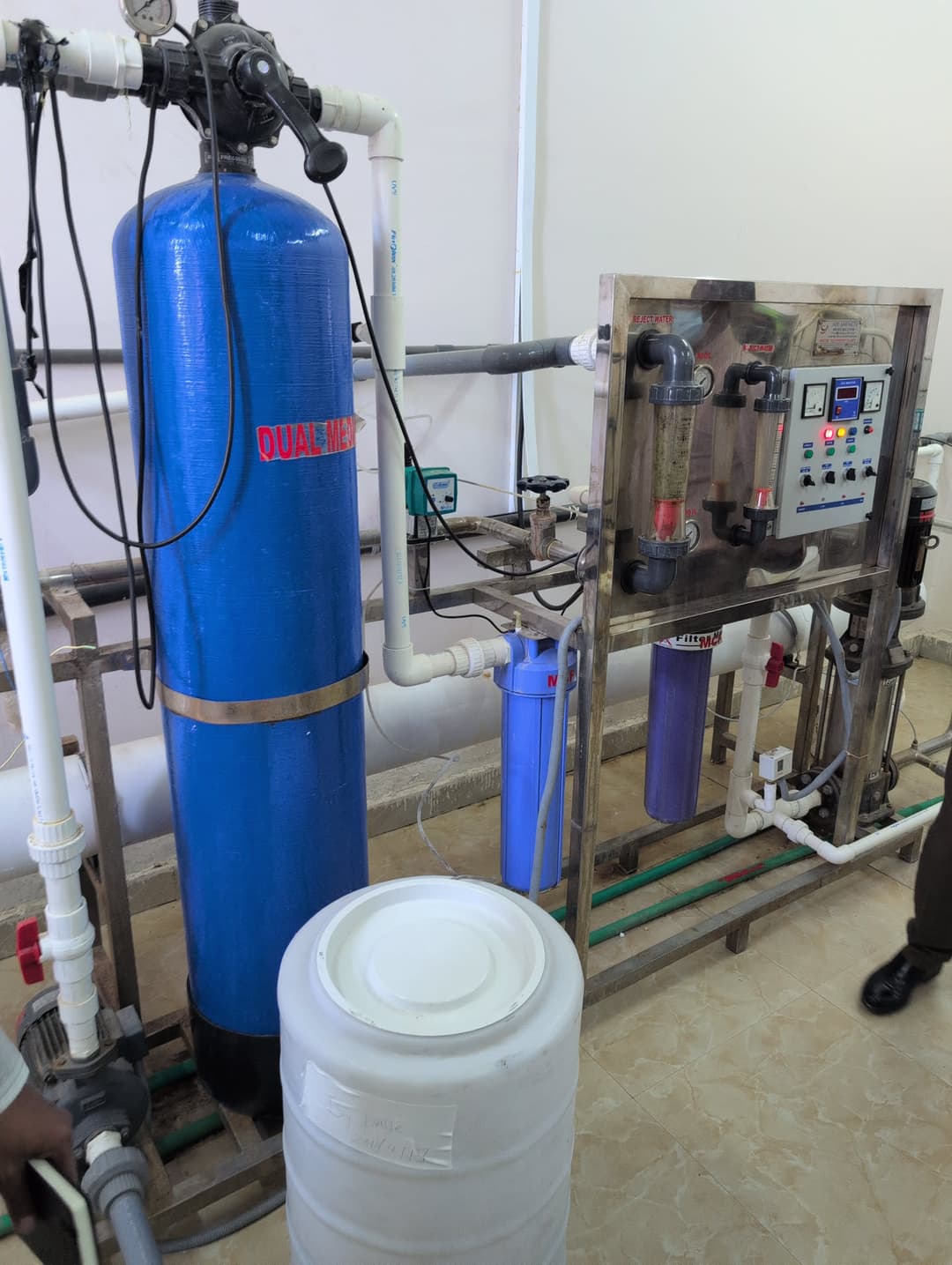
The RO system at Jigjiga. Source water at 1,380 ppm TDS is brought below 10 ppm for dialysis use.
Annual water system consumables (hover to explore)
Component costs based on AAMI ANSI/AAMI RD52 standards and Kasparek & Rodriguez, CJASN 2015;10:1061-1071. Annual totals vary by center size and local sourcing.
What dialysate actually is
Dialysate is the cleaning fluid on the other side of the membrane, the thing that extracts waste from blood. It’s not exotic. It’s mostly purified water mixed with table salt, baking soda, potassium, calcium, magnesium, and a little glucose.
The concentrations matter precisely. But precision here is a mixing problem, not a sourcing problem. A proportioning pump blends two off-the-shelf concentrates with purified water at roughly 1:34.
Ingredient cost per session (hover to explore)
Estimated raw ingredient costs per session. In practice, dialysate is purchased as pre-mixed acid and bicarbonate concentrates ($1 to $3 combined). Source: Karopadi et al., BMC Health Services Research 2013.
What a session actually costs
Cost per session breakdown
At $50 per session, a patient needs $7,800 per year (3x/week, 52 weeks). In the US, the USRDS estimates annual per-patient costs above $90,000. Medicare spends $36 billion per year on end-stage kidney disease alone.
Where the money goes
Consumables (dialyzer, tubing, needles, saline) account for 70 to 85% of total costs in low-income settings. They are manufactured plastic and basic chemistry. The machines are a one-time cost.
Tying it all together
What’s missing is coordination. Water infrastructure funding is scoped to access, not purification grade. Health funding is scoped to drugs and equipment, not infrastructure. The two systems don’t talk to each other, and dialysis centers fall in the gap between them.
Water Purification
One RO system can serve an entire center. Solar power is making electricity less of a constraint.
Local Consumables
Dialyzers and tubing are manufactured plastic. Regional manufacturing partnerships could cut costs significantly.
Technician Retention
Four broken machines because trained techs leave. Modest stipends above market rate change the math.
Partnerships Over Purchases
Diaspora-led organizations are already connecting overseas resources to local clinics. Equipment manufacturers, water companies, and regional governments are the other pieces.
Dialysis due to bad water is cheap to prevent.
The $2 cost of water purification targets dialysis grade: under 10 ppm. Bringing tap water down to safe drinking levels (500 ppm) costs less and reduces the mineral load that researchers link to kidney damage over time.
Organizations like Splash already focus on water quality and its downstream health effects.
Water infrastructure is usually framed as an access problem. In eastern Ethiopia, access already exists. The problem is what’s in the water. Investment in quality (mineral filtration, TDS reduction) is also investment in kidneys that won’t fail a decade from now.
Fixing water quality now means fewer people needing much more expensive interventions later.
Disclosure: Field assessment graciously organized and facilitated by Amoud Foundation. CharitySense received no compensation of any kind and has no affiliation with any organization mentioned.
Sources & Further Reading
- World Bank / WEF: Global Public Spending on Water (2025) -Current global water infrastructure investment ~$350B/yr (~$41/person); UN SDG target requires ~$1 trillion/yr by 2030
- OECD: Water and Sanitation ODA -$9 billion in annual WASH development aid
- IRC WASH: Water Point Mapping -50,000 failed water supply points in sub-Saharan Africa
- EPA: Drinking Water Regulations -Safe drinking water standards (500 ppm TDS)
- PMC: Chronic Kidney Disease of Unknown Etiology -Link between water contaminants and CKD
- Nature Communications: Global Analysis and Prediction of Fluoride in Groundwater (2022) -180 million people exposed; Africa and Asia bear 90% of burden
- BMC Public Health: Fluoride in Ethiopian Rift Valley Groundwater (2019) -Meta-analysis; fluoride 7.8-18 mg/L; 8 million at risk; 28% dental fluorosis prevalence
- Journal of Chemistry: CKDu and Groundwater Geochemistry, Sri Lanka (2021) -Fluoride in 99% of endemic wells; water hardness and fluoride linked to CKDu
- UNICEF Ethiopia: Fluoride and Stained Teeth -Visible fluorosis in Ethiopian communities from groundwater fluoride
- World Bank: Somalia Groundwater Quality Technical Note -Groundwater quality assessment in the Somali region
- ScienceDirect: Fluoride Contamination in Groundwater - Global Review -Comprehensive review of fluoride contamination sources and health effects
- ScienceDirect: Fluoride & TDS in Ethiopian Rift Valley Aquifer -Fluoride and total dissolved solids in Rift Valley groundwater
- PMC: Drinking Water Quality and Health Risks in Adama, Ethiopia -Health risk assessment from groundwater contamination
- PMC: Fluoride in Groundwater - Ethiopian Rift Valley Meta-Analysis -Systematic review of fluoride levels and fluorosis prevalence
- The Lancet: Global Burden of Disease Study 2023 -CKD as ninth leading cause of death, 4M projected deaths by 2040
- IHME: CKD Has More Than Doubled Since 1990 -800 million adults affected worldwide
- The Lancet Global Health: Kidney Disease in Africa -84% discontinuation rate, 15.6% CKD prevalence in sub-Saharan Africa
- BMC Health Services Research: Dialysis Costs -Per-session costs across settings, consumables at 70 to 85% of costs
- USRDS: Annual Data Report -$90,000+ annual US per-patient cost, $36 billion Medicare spend
- Renal Fellow Network: Water Treatment for Hemodialysis -Overview of RO systems and water purity standards; cites Kasparek & Rodriguez, CJASN 2015;10:1061-1071
- Shutterstock: Hemodialysis circuit illustration (#1916589080) -Educational illustration adapted for this essay. To cite: [Contributor name] / Shutterstock.com (see image page for contributor).
- Amoud Foundation -Diaspora-led healthcare infrastructure in the Somali region