ProPublica Nonprofit Explorer
13 Red Cross filings with annual-extract data; older filings are PDF-only
13 extracted filings plus 11 PDF-only filings for Red Cross
A note on nonprofit data access
Understanding the US nonprofit landscape today is expensive and uneven in quality. That seems like a shame, because the underlying records are already public.
IRS Form 990 filings are public. The searchable, comparable evidence layer often is not.
IRS 990-series filings that should be free to explore
We started this work wanting a simple thing: to ask plain questions about American nonprofits and get answers grounded in their actual filings. What we found is that the good answers tend to live behind a subscription. Cause IQ lists its Pro plan at $5,988/year for three users, with a Core plan at $349/month and bulk exports priced at $0.50 per exported record. Candid (GuideStar) lists Premium at $1,199/year, with a newer Ultimate tier at $1,699/year that adds compliance data.
These are real products built by people who did genuinely hard work. Form 990 filings arrive messy, and turning them into clean, comparable profiles takes effort that deserves to be paid for. So we want to be clear up front: the case here is not against paid tools. The case is that a free public baseline should also exist, because the source records are already public.
The Form 990 is the primary public disclosure document for the US nonprofit sector. When a charity receives tax-exempt status, raises public money, and files public returns, it seems reasonable that donors, journalists, researchers, grantmakers, and builders should be able to ask basic questions of those returns without first clearing a procurement budget.
The standard we kept coming back to is simple: if the disclosure is public, a serious way to search it should be public too.
The distinction that matters is not whether a landing page is free. It is whether the useful query layer, the part that lets you compare, filter, and trace evidence, is free.
Every serious question about a US nonprofit eventually comes back to its Form 990. The return carries revenue, expenses, program spending, fundraising, executive compensation, governance answers, grants made, contractors paid, foreign activity, related organizations, the balance sheet, and functional expenses. When we processed the corpus, we counted roughly 417 extracted fields per filing, which is a lot of structure to work with once it is parsed.
So the data is not secret. The difficulty is that it is hard to use. A donor can find a PDF. Sometimes an XML file. Sometimes a profile page. But the question someone actually has is rarely whether they can download the document.
The practical questions are not about documents. They are about trust, cost structure, governance, and where the money goes.
The public filing system answers those questions only for people who already know how to pull the answer out of the form. For a record meant to support public transparency, that is a high bar to entry.
A large archive is not the same thing as an analytical dataset. The work that makes filings comparable is extraction: pulling out the program expense ratio, fundraising and admin spend, revenue growth, asset strength, governance signals, executive compensation, grantmaking, foreign activity, related organizations, contractors, and the schedule-level detail underneath them. To do that cleanly across the corpus we built a concordance of 10,231 element definitions and 4,034 alias rules that fold into 2,708 canonical fields, which let us match about 2.36 billion codebook fields at full type integrity.
That mapping work is also where coverage is won or lost. 990-EZ returns are about a third of all filings we see, and the short form is where most tools thin out. After we corrected our element mapping, EZ revenue coverage rose from roughly 5% to about 98.5%, which appears to be a depth most public tools do not reach.
The next layer is Schedule I and Schedule F. Schedule I records grants to domestic organizations, and Schedule F records foreign activity and foreign grants. Read together, they begin to answer a question most charity sites cannot answer cleanly.
The question is not only how much money came in. It is where the money went.
Most nonprofit databases describe organizations. That is useful, but it treats each nonprofit as a single data point, and a nonprofit is really a sequence of filings. Across our corpus there are about 790,000 US organizations and roughly 7.07 million IRS 990-series filings, which works out to about seven filings per organization. Serious analysis needs that history: the latest return, the older ones, the schedules, the changes between years, and the raw evidence behind each summary.
| Source | Organizations covered | Filings | Depth | Evidence |
|---|---|---|---|---|
| CharitySense Data | ~790K U.S. nonprofits | 7M+ IRS Form 990 filings | Search, full organization profiles, filing history, normalized financials, governance, ratings, officer compensation, foreign activity, and a no-auth read-only API. | Developer page |
| GuideStar / Candid | 1.8M IRS-recognized tax-exempt organizations, plus faith-based nonprofits | Aggregate filing count not publicly stated on the source page | Profiles built from 990s and direct reporting, with financials, leadership, mission data, paid tiers, and API products. | GuideStar search |
| Cause IQ | Over 1.8M IRS-registered tax-exempt organizations | Aggregate filing count not publicly stated on the source page | Digitized and cleaned 990s, organization profiles, grant data, personnel, vendors, funding sources, benchmarking, and 400+ paid filters. | 990 methodology |
| Charity Navigator | More than 225,000 rated charities, per its own about page | Not positioned as a filing archive; ratings use Form 990 and self-reported inputs | Rating-focused profiles covering cost-effectiveness, program health, stability, efficiency, sustainability, and methodology-driven signals. | About page |
| ProPublica Nonprofit Explorer | A large multi-decade public archive of tax-exempt organizations | Millions of tax filings, both extracted and raw-document | Free filing archive with annual returns, executive compensation, revenue, expenses, full-text filing search, and public API access. | Explorer data |
Where a source publishes organization coverage but not a verifiable total filing count, we have left the filing count described rather than inferring a precise number from profile counts. ProPublica Nonprofit Explorer is an important public exception here, especially as a raw filing archive with an open API.1
A profile database tells you an organization exists. A filing database lets you ask what changed. A structured filing database lets you begin to ask why.
Here is where today's options land, with prices confirmed against each provider's own page in June 2026. Each of these products earns its price by cleaning, enriching, and presenting filings well.
| Product | Price | Term | What's included | Evidence |
|---|---|---|---|---|
| Cause IQ Pro | $5,988/year | Annual plan; three users included. A $4,488/year nonprofit rate is also listed. | Core search and profile depth, bulk exports with no hard caps, grant lists up to 3,000 per download, benchmarking, data enrichment, and onboarding. | Cause IQ pricing |
| Cause IQ Core | $349/month | Monthly plan; a $199/month rate is listed for 501(c)(3) nonprofits. | 400+ nonprofit search filters, detailed profiles, key personnel, vendors, funding sources, grants made, and bulk exports priced at $0.50 per exported record. | Cause IQ pricing |
| Candid (GuideStar) Premium | $1,199/year | Annual plan; Premium is also listed at $219/month billed monthly. | Unlimited search and full profile views, grants data, detailed financials, dashboards, saved lists, peer benchmarking, and download allowances. | Candid pricing |
| Candid Ultimate | $1,699/year | Annual plan; newest Candid tier. | Everything in Premium plus compliance data layered on top of the profile and financial detail. | Candid pricing |
| ProPublica Nonprofit Explorer | $0 | Free public web archive with a free public API. | Annual returns, executive compensation, revenue and expense data, full-text filing search, and raw filing documents across a large multi-decade public archive. | Explorer data |
| CharitySense Data | $0 | Free public web search and free read-only API, no authentication required. | Searchable nonprofit profiles, filing history, normalized 990 fields, governance and rating signals, officer compensation, foreign activity, and plain-English questions. | Developer API |
We want to be fair about what these tools give back. Cause IQ Pro removes export caps and ships grant lists up to 3,000 records per download. Candid layers benchmarking, dashboards, and now compliance data on top of the profile. ProPublica Nonprofit Explorer is a genuinely valuable free archive with a public API, and it does much of what we think a public baseline should do.
So this is not an argument that paid products should disappear. It is an argument that a free, current, structured way to search public filings should sit alongside them. The baseline does not need to replace paid research tools. It does need to be more than a PDF scavenger hunt.
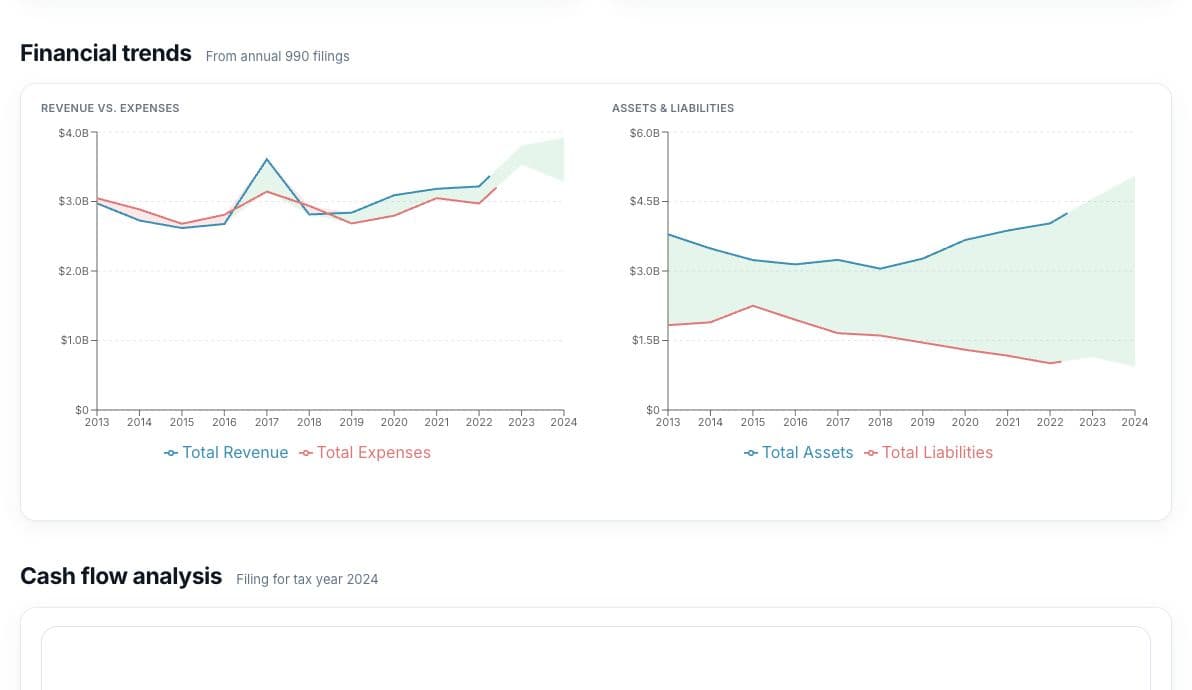
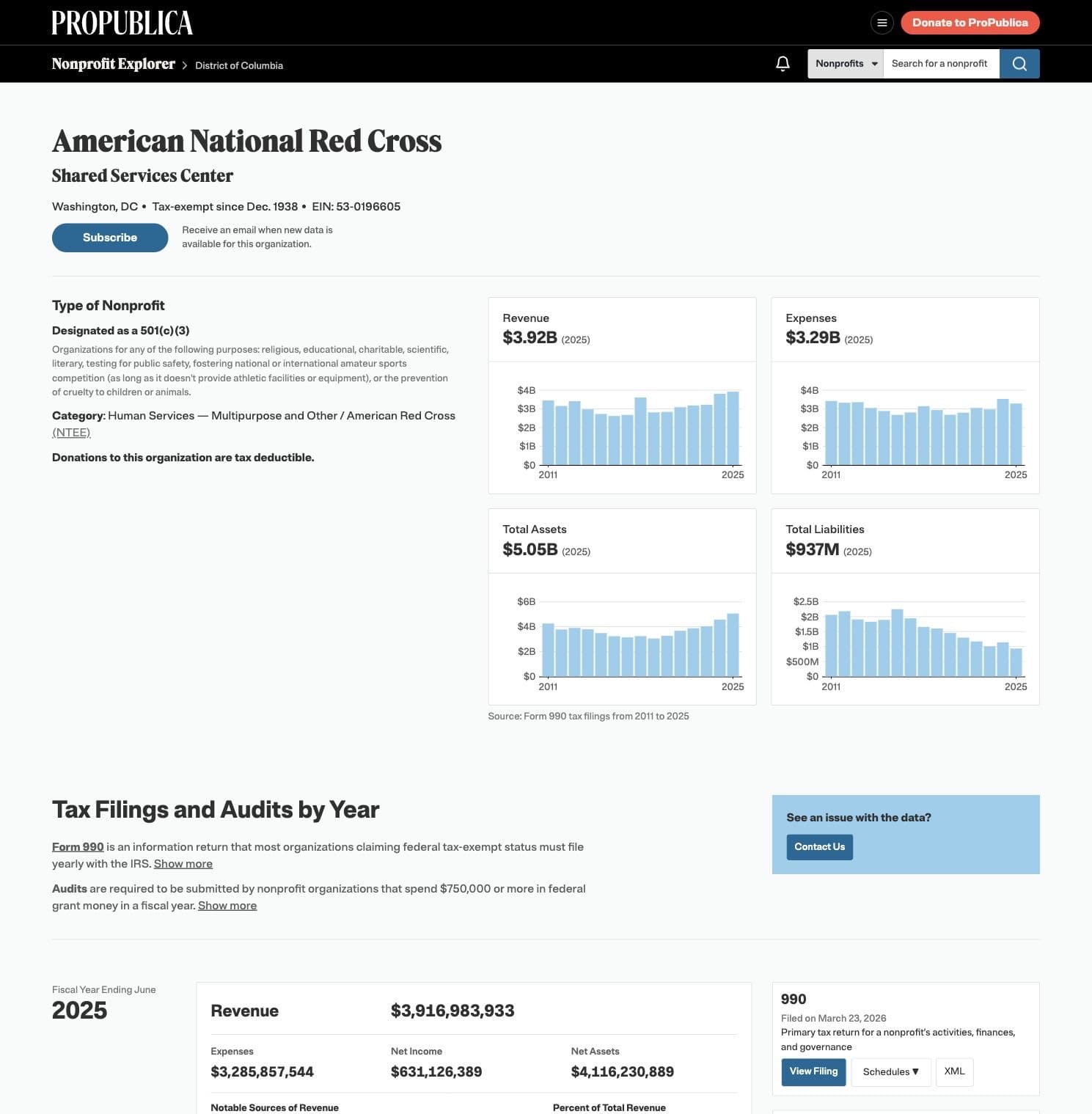
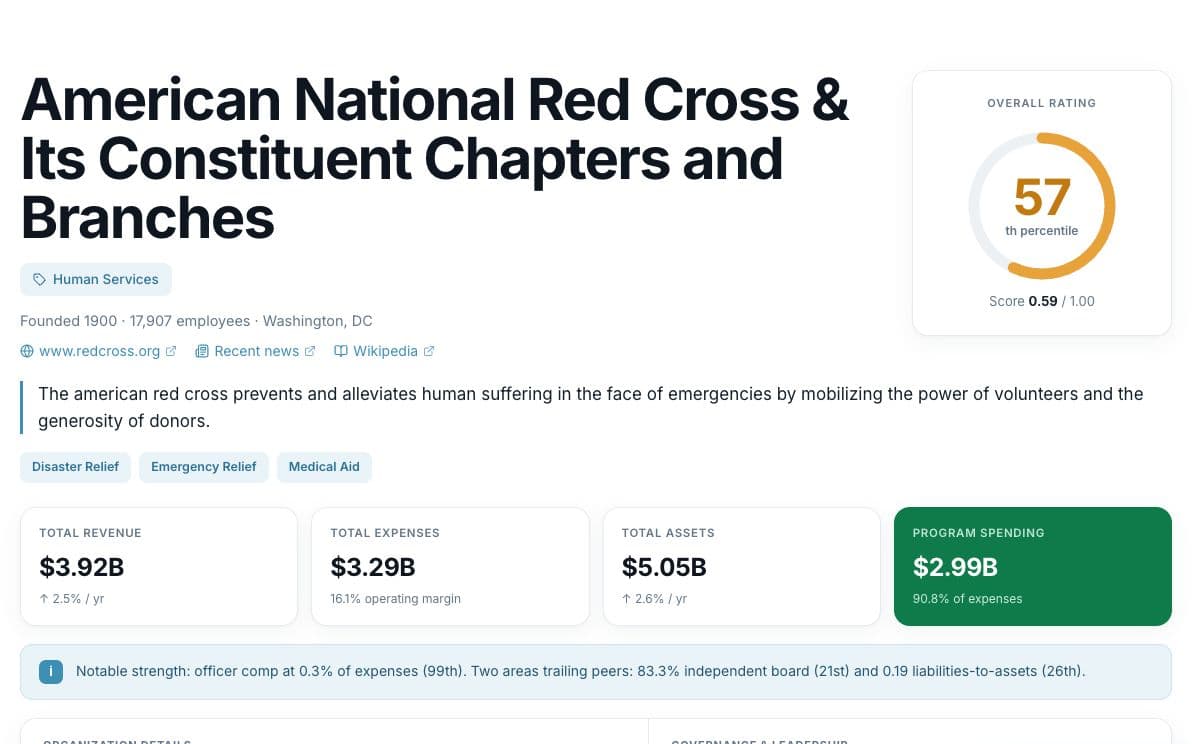
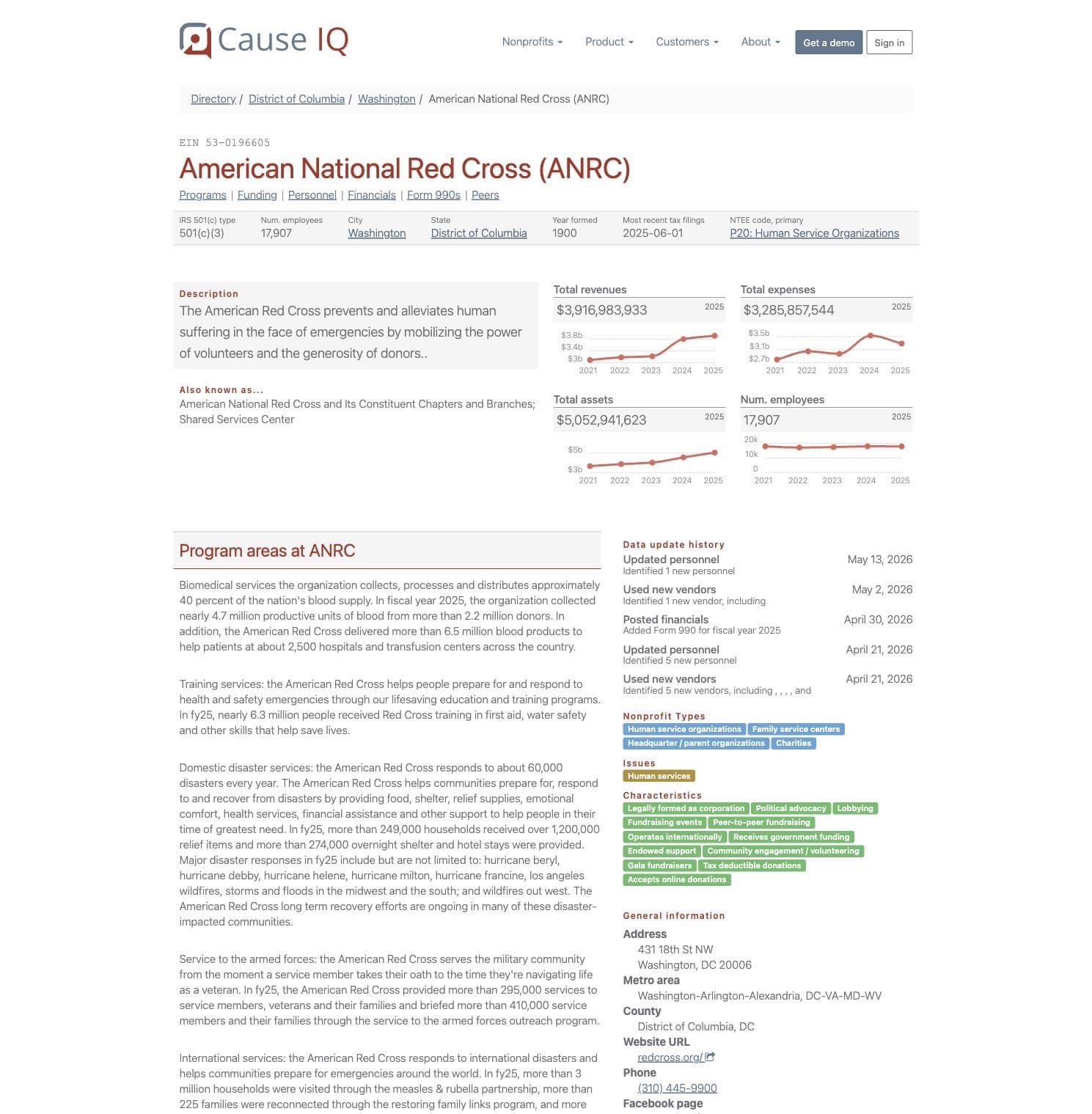
To make this concrete, we looked at the American Red Cross, EIN 53-0196605, and compared what each existing site exposes publicly for that one charity. The method was simple: fetch the public page or API response, strip navigation and page-framework noise, then count the non-empty structured facts that remain.2
13 Red Cross filings with annual-extract data; older filings are PDF-only
13 extracted filings plus 11 PDF-only filings for Red Cross
Two recent digitized financial years shown publicly
Cause IQ describes five recent 990s for most organizations
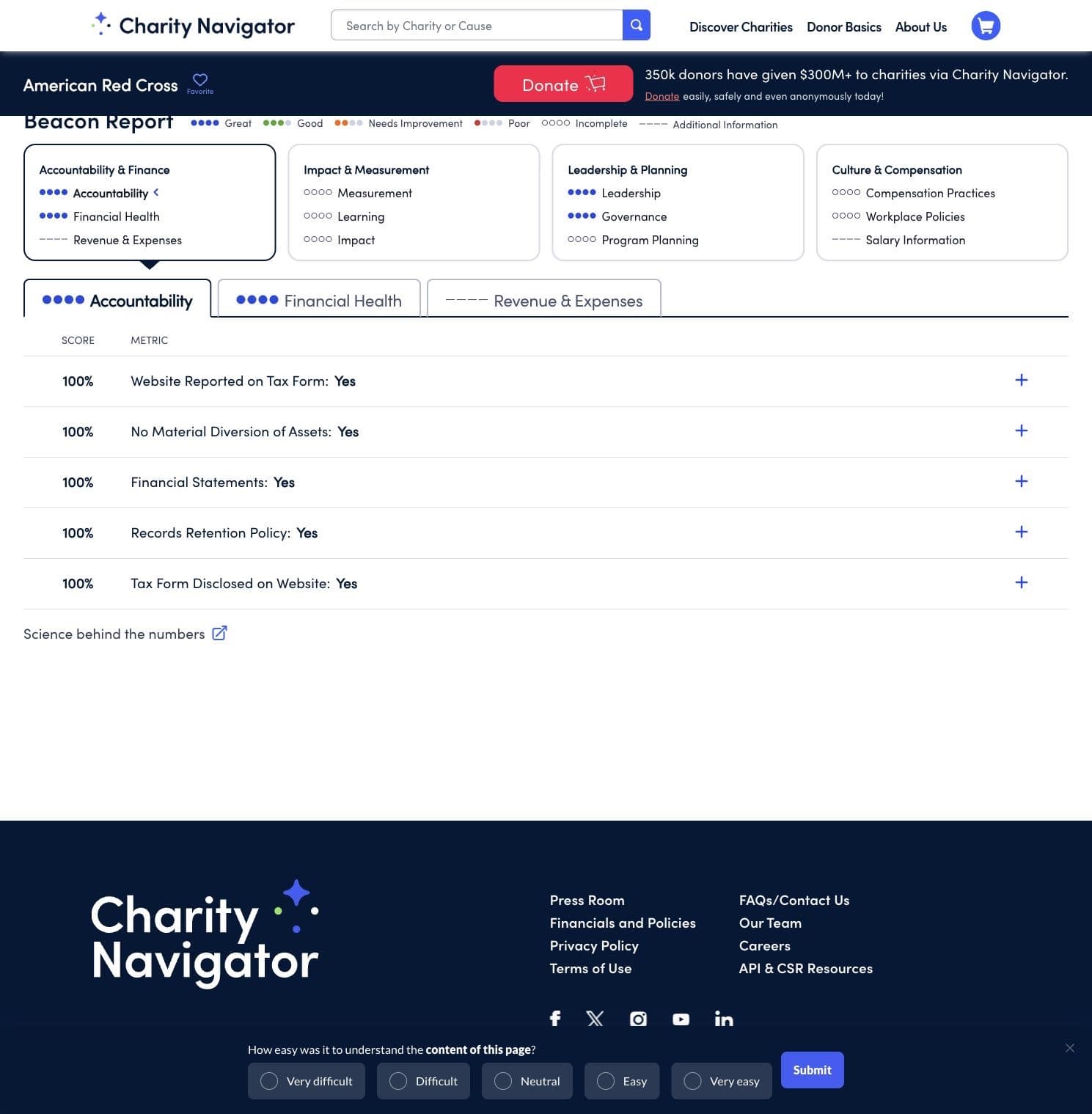
Current rating profile; not a historical filing archive
Ratings require at least 3 years of IRS Form 990 filings
Limited unauthenticated public profile in this benchmark
Candid offers Form 990 lookup; deeper profile access may require account or paid tier
This is not a perfect benchmark, and we want to be careful about reading too much into it. Sites expose data differently, paid products hold more behind a login, and some pages are built for people rather than machines. That caveat is also the point. The question we care about is not presentation. It is whether the public layer preserves enough of the filing for a reader or an agent to check the conclusion against the source.
A listing is an index entry. A research object carries history, numbers, people, governance signals, schedules, and the evidence behind the summary.
Our attempt
We built CharitySense Data as a deliberately different attempt at the same problem: the deepest, highest-quality, non-biased extraction of public IRS 990 data we could manage, kept free and behind no paywall. It covers about 790,000 US organizations across roughly 7 million IRS 990-series filings, starting from the raw returns and computing financial health, governance, growth, efficiency, officer compensation, grantmaking, and foreign-activity signals on top of them.
Placed against the same American Red Cross benchmark, the difference is about more than price. It is whether the public layer keeps the filing intact as a research object: history, financials, governance, officers, grants, foreign activity, raw evidence, and a rating that traces back to the underlying fields rather than standing on its own.
12 structured Red Cross filings in the benchmark
Structured filing history back to 2012
13 Red Cross filings with annual-extract data; older filings are PDF-only
13 extracted filings plus 11 PDF-only filings for Red Cross
Two recent digitized financial years shown publicly
Cause IQ describes five recent 990s for most organizations
Current rating profile; not a historical filing archive
Ratings require at least 3 years of IRS Form 990 filings
Limited unauthenticated public profile in this benchmark
Candid offers Form 990 lookup; deeper profile access may require account or paid tier
That shifts the starting point. A donor, journalist, researcher, grantmaker, builder, or agent can begin from the structured public record instead of assembling one from scattered PDFs, partial profiles, and paid exports.
The traditional interface to nonprofit data was an identifier: “What are the financials for EIN 13-1760110?” That works if you already know the EIN. But most people do not think in EINs. They think in causes, places, trust, cost, and outcomes. So we made the data answerable in the language people actually use.
Nonprofit data lookup has mostly been retrieval. With deeper structured extraction it starts to become research, and with schedule-level extraction it can become flow analysis: which US charities send grants to education programs abroad, which organizations fund the same downstream partners, and which nonprofits report foreign activity but little program detail. In our corpus only about 3% of organizations report any foreign activity, and those that do appear to be roughly eight times larger than average, which is the kind of pattern a queryable dataset surfaces quickly.
Whether a charity is credible enough to receive a gift, and how much confidence to place in that choice.
Where should I give? How much reaches programs? Is the organization financially healthy?
Which organizations deserve funding, renewal, deeper diligence, or a change in grant size.
Who has capacity to absorb funding? Who is growing? Which grantees show governance or reporting risk?
How to compare charities across mission fit, financial health, governance, execution risk, and portfolio role.
Which peer is stronger? How do program ratios compare? What changed since the last filing?
Which patterns, contradictions, related-party links, or money flows deserve investigation.
Who funds whom? Which filings show unusual compensation, contractors, grants, or foreign activity?
How to turn public nonprofit evidence into products, workflows, comparisons, and agent-readable research.
Which API fields support this workflow? Can an agent compare three charities and cite filing evidence?
In each case the person asking does not just need a filing. They need enough structured evidence to judge whether an organization is credible, comparable, risky, efficient, underfunded, overfunded, or worth a second look.
That is why searchability matters more than storage. The first step is a public data site. The next is making the same data usable inside the tools people already work in, including the AI agents that now do a growing share of first-pass research.
Agent-readable nonprofit data should return structured evidence, not a pile of PDFs.
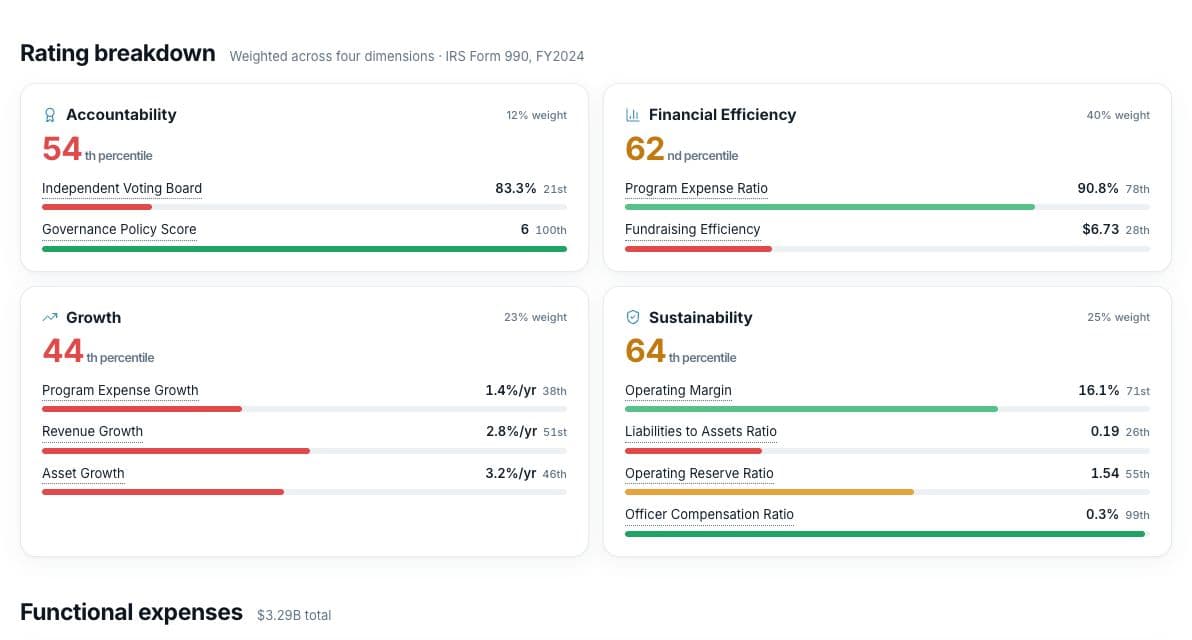
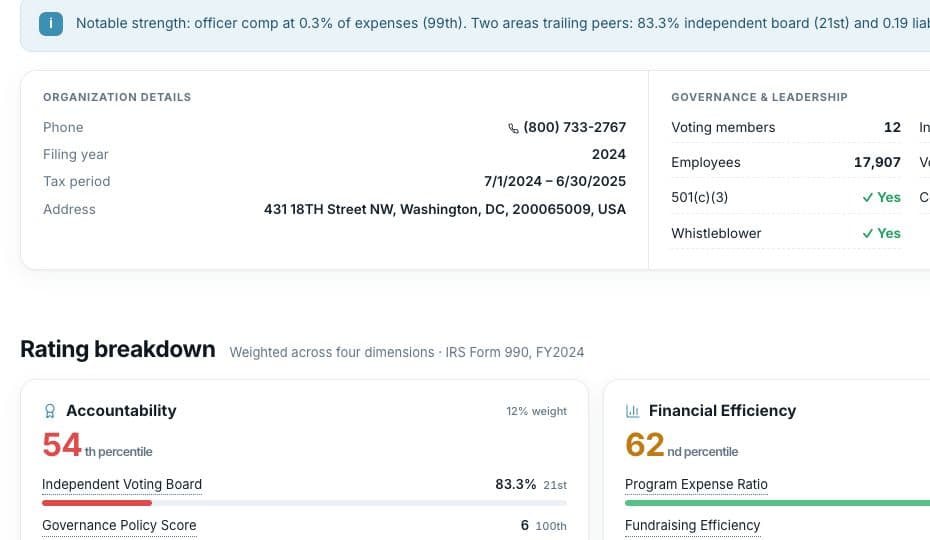
Consider the American Red Cross again. A useful profile page should do more than label a charity good or bad. A single verdict is too thin to act on. It should show the evidence that produced the verdict, so a reader can weigh it themselves.
ProPublica’s strongest visible public element is historical financial presentation from annual returns. CharitySense puts comparable financial evidence near the top, then connects it to filing history, normalized fields, governance signals, ratings, and API access.
Cause IQ’s public page is strongest as a compact financial and profile summary, with deeper filtering, benchmarking, exports, and richer detail tied to subscriptions. CharitySense keeps the comparable summary and structured read API in the same free baseline.
Charity Navigator’s strongest element is the donor-facing rating. CharitySense also surfaces a score, but keeps the underlying filing evidence close by: financials, governance fields, officers, schedules, history, and source data.
GuideStar / Candid’s public page emphasizes access to 990s, revenue, expense data, and leadership information after registration or product access. CharitySense puts the profile, financial summary, and agent-readable evidence directly on the public page.
With that in view, better questions become askable. Is the organization growing? Does spending match the mission? Are fundraising costs reasonable? How does it compare with peers? Does the filing show foreign grantmaking? Who are the officers? What changed over time?
The aim is not to replace human judgment. It is to lower the cost of exercising it carefully.
The nonprofit sector seems to have a feedback-loop gap. Money moves, the filings follow later, and the filings are public. But the useful analysis on top of them is fragmented, delayed, expensive, or hard to reproduce.
That is the direction we are trying to move: from public documents to public queries.
Free is doing real work here, not standing in as a marketing adjective. It changes who can use the data. A donor deciding where to give $500 should not need an enterprise subscription. A journalist should not need a procurement cycle. A small nonprofit should not have to pay to understand its own peer group.
A developer building a donor tool should not need to ask permission to call a read-only public-data API. A researcher should not have to choose between data that is stale and data that is expensive.
Free also keeps the data from being trapped inside someone else's interface. A public record reads better when it can flow into personal, institutional, and proprietary workflows alike.
Pull 990 fields into a private spreadsheet or CRM, then combine them with client preferences, giving history, and notes.
Attach revenue, expense, governance, and filing-history signals to grant applications before a renewal meeting.
Query a charity, store the API response, cite the filing evidence, and reproduce the same analysis later.
Let a private agent compare charities against your own rubric without moving donor lists or strategy into a vendor dashboard.
More people can ask better questions only if the base layer is open.
PDFs are necessary but not enough. Profile pages are useful but incomplete. Paid dashboards add real value, and we hope they keep doing well, but they should not be the only practical way to analyze public disclosures.
CharitySense Data is our attempt at the free baseline: the deepest, highest-quality, non-biased extraction of public IRS 990 data we could build, kept current, structured, searchable, answerable in plain English, agent-readable, and behind no paywall. Hopefully a public baseline like this makes it a little easier for more people to understand where the money goes.
1.ProPublica’s Nonprofit Explorer is an excellent public resource and has a broader archive of raw filing documents. Its own API distinguishes between filings with extracted data and raw PDF filing documents with only basic metadata. The comparison above is about publicly exposed structured facts for a single charity, not raw document archive size.
2.The American Red Cross comparison counted non-empty structured facts visible through public pages or public API responses. It excluded navigation, menus, script framework data, styling, and page chrome. The checkmarks in the table refer to structured public evidence in that sampled view, not every field a paid product may contain behind login. The method is imperfect, but useful because it measures how much structured information a user or agent can retrieve without logging in or paying.